
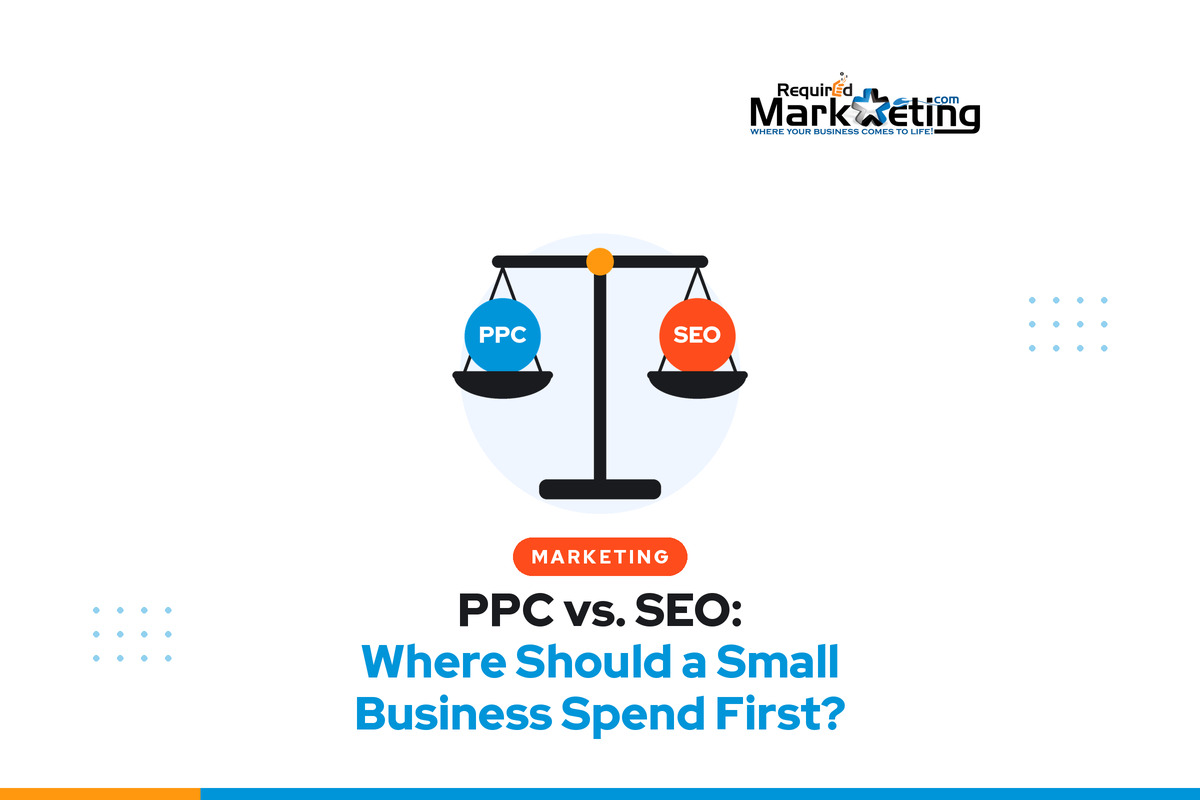
If you have a limited marketing budget, one of the first big questions is where to put it: paid search ads or search engine optimization. Both can bring customers to your website from Google. They just work on very different timelines and cost structures.
There is no single right answer for every business, but there is a right answer for yours. This guide walks through how each option works, what it costs, and a simple way to decide where to start.
The Short Answer
- Choose PPC first when you need leads soon, you are launching something new, or you want to test which searches bring in customers.
- Choose SEO first when you can wait for results, your budget is tight month to month, or clicks in your industry are expensive.
- Plan for both over time. Many small businesses use paid ads for speed while SEO builds long-term visibility.
Now for the details.
How PPC Works
PPC stands for pay-per-click. With search ads, such as Google Ads, you bid to show your ad when people search for certain terms, and you pay when someone clicks.
Google explains that you often pay less than your maximum bid, because in its ad auction you only pay what is minimally required to beat the ad ranked just below yours.
You also stay in control of your budget. You set an average daily budget, and Google says your spend can vary from day to day, but you will never pay more than two times your average daily budget on any given day for most campaigns, or more than 30.4 times your average daily budget in a month. Using Google’s own example, a $10 daily budget means a maximum of $304 for the month.
What PPC Typically Costs
Costs vary widely by industry and location. For a general sense of the market, WordStream by LocaliQ analyzed more than 13,000 search ad campaigns across 23 industries running from April 2025 through March 2026. Its 2026 Google Ads benchmarks found:
- Average cost per click: $5.42
- Average click-through rate: 6.64%
- Average conversion rate: 8.18%
- Average cost per lead: $66.69
Industry matters a lot. In the same report, average cost per click ranged from $1.63 in Arts and Entertainment and $2.05 in Restaurants and Food to $8.33 in Home and Home Improvement and $9.87 in Attorneys and Legal Services. Treat benchmarks as a reference point, not a forecast for your own account.
How SEO Works
SEO, or search engine optimization, is the work of making your website clear, useful, and easy for search engines to understand, so it can earn a place in the regular (organic) search results.
You cannot buy those positions. Google states that it does not accept payment to rank pages higher, and that ranking is done programmatically. You earn visibility through helpful content, a technically sound website, and a trustworthy reputation.
SEO also takes patience. Google says some changes might take effect in a few hours while others could take several months, and it suggests waiting a few weeks before judging whether a change helped.
PPC vs. SEO, Side by Side
- Speed: PPC can start sending traffic as soon as your ads are approved and running. SEO builds over weeks and months.
- Cost structure: PPC is an ongoing cost for every click. SEO is mostly an investment of time and expertise, with no charge per visit.
- Control: PPC lets you choose exactly which searches, locations, and hours to target. With SEO, Google decides what to show based on its ranking systems.
- Staying power: PPC traffic generally stops when you stop paying. SEO results can keep working long after the work is done, as long as your site stays healthy.
- Learning: PPC data shows quickly which searches lead to calls and sales. SEO teaches you what content your customers value over time.
When PPC Should Come First
Paid search often makes sense as a first step when:
- You are new and have no search visibility yet.
- You are launching a service, location, or promotion and need people to know now.
- Your business is seasonal and you need to capture demand in a short window.
- You want to test keywords before investing months of SEO work in them. Search ad data can show which terms actually bring in leads.
The key is to start small, track results carefully, and send every ad to a page that matches the search with one clear offer and one clear next step.
When SEO Should Come First
Starting with SEO often makes sense when:
- Your monthly budget is tight and you would rather invest in something that keeps working.
- Clicks in your industry are expensive, so even a modest ad budget would not go far.
- Your customers research before they buy and want helpful information, not just an ad.
- Your website has basic problems, like a poor mobile experience or unclear service pages. Those problems hurt ads too, so fixing them first helps every channel.
Why the Best Answer Is Often Both, in Stages
For many small businesses, the smartest plan is not either-or. It is a sequence:
- Fix the foundation. Make sure your website is fast, mobile-friendly, and clear about what you do and where.
- Start a focused ad campaign. Target a small set of high-intent searches in your service area and track every lead.
- Use what you learn. Let the search terms that convert guide your SEO content.
- Build organic visibility. Publish helpful pages and earn reviews and links over time.
- Rebalance. As organic traffic grows, adjust your ad budget to fill gaps, promote offers, and cover seasonal peaks.
Questions to Answer Before You Spend
Whichever way you go, answer these questions first:
- What counts as a conversion? A call, a form, a booking, or a purchase?
- Is tracking in place? You need to know which clicks and visits turned into leads.
- What is a lead worth to you? Knowing your average sale and close rate tells you how much you can afford to pay for a lead.
- Who will manage it? Both PPC and SEO need regular attention. Ads left on autopilot can waste money, and SEO without a routine tends to stall.
If you would like expert help with paid search, our pay-per-click (PPC) management team builds keyword lists, writes ad copy, aligns landing pages, and keeps monitoring and adjusting your campaigns, and our SEO team can build the long-term side of your search plan.
Let’s Find the Right Starting Point for Your Budget
The best search strategy is the one that fits your goals, your timeline, and your budget. If you would like a second opinion on where to start, Required Marketing Group Inc. would be glad to help you weigh your options.
Request a quote at https://requiredmarketing.com/quote-request/ and tell us about your goals. You can also email us at [email protected] or call our main line at (844) 978-1051.